
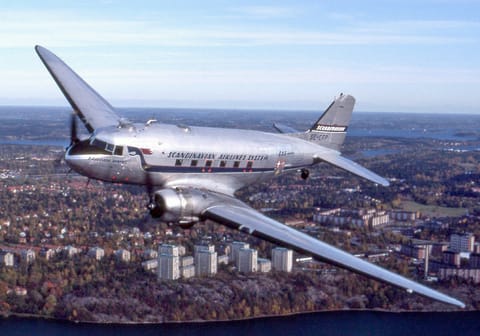
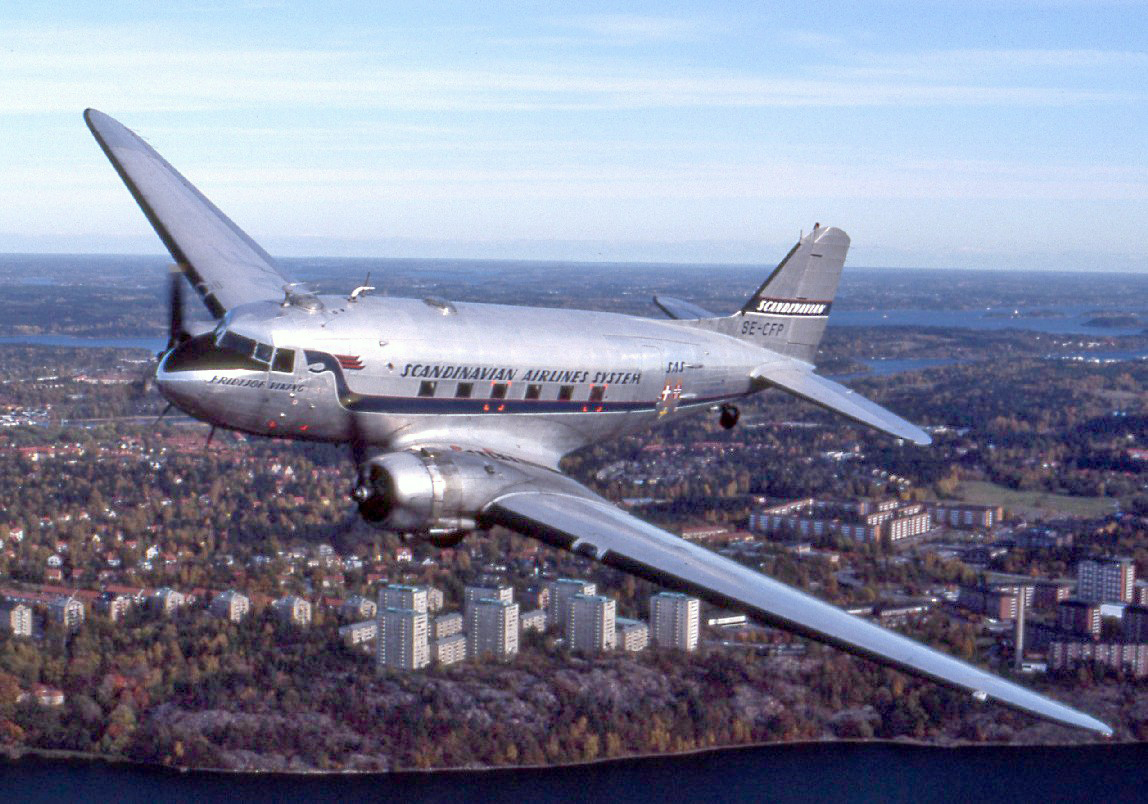
Railway Air Services Dakota: Failure to Climb, Northolt, 1946
On the evening of 19 December 1946, a Douglas Dakota of Railway Air Services lifted off from Northolt Aerodrome in west London, flew a short distance and came down on the roofs of two houses in South Ruislip. All five people on board left the aircraft unhurt. The cause was ordinary but serious: snow had frozen onto the wings while the aircraft waited for clearance to depart.
Key facts
- Date: 19 December 1946
- Aircraft: Douglas Dakota 3, registration G-AGZA
- Operator: Railway Air Services, flying on behalf of Scottish Airways
- Route: Northolt, London, to Renfrew Airport, Glasgow
- People on board: 5 (4 crew, 1 passenger)
- Fatalities: 0
- Site: about 1 km (half a nautical mile) north-east of Northolt, in Angus Drive, South Ruislip
- Cause: failure to climb because of snow and ice on the wings
The aircraft
G-AGZA was built in 1944 as a Douglas C-47A, the military transport version of the Dakota, for the United States Army Air Force. It later passed to the Royal Air Force with the serial KG420. In March 1946 it was registered to Railway Air Services as a Dakota 3. It was powered by two Pratt & Whitney R-1830-92 Twin Wasp piston engines.
The flight
A long wait in worsening weather
The Dakota was scheduled to fly from Northolt to Renfrew, serving Glasgow. The evening was cold and snowy, and the weather had already delayed the departure. The snow had closed the airport to arriving traffic, and departures faced long waits. The crew had the aircraft de-iced, but the aircraft then waited for more than an hour for clearance.
During that wait the temperature fell and snow kept falling. It froze on the wings, so the de-icing was undone. By the time the aircraft taxied into position for take-off, the wings were covered.
Take-off
When clearance came, the pilot ran the engines up to 45.5 inches of manifold pressure and 2,500 rpm. Manifold pressure is a measure of how much power a piston engine is producing, and rpm is the speed at which the engine turns. These were normal take-off settings.
The Dakota accelerated along the runway and left the ground, but it would not climb. Ice and snow on a wing spoil the smooth flow of air over its surface, which reduces lift. By the time this became clear, it was too late to stop on the runway. The pilot had to try to make the aircraft climb.
The Dakota flew only a short distance above the ground, straight down Angus Drive beyond the end of the runway. Its left wing touched some rooftops, and the aircraft swung through about 90 degrees. It came to rest on the roofs of two houses, numbers 44 and 46.
After the impact
The aircraft was severely damaged. The radio officer was not in his seat when the impact came, and some metalwork was pushed through it. Nobody was hurt. The crew and the passenger climbed into the loft of one house, came down the loft ladder to the landing, went downstairs and left by the front door.
Two residents were at home in one of the houses, a mother and her four-month-old son. The child was asleep upstairs and is said not to have woken. The aircraft was written off. The house was badly damaged, and repairs took about six months. Oil stains are reported to have reappeared in the ceilings for roughly ten years afterwards.
The investigation
The cause was established quickly. Snow had frozen onto the wings while the aircraft waited, and with that contamination it could not gain height. The pilot was also found to have made an error of judgement by taking off when the aircraft was almost entirely covered with snow. Both findings were recorded as causes.
The episode left a mark on local memory. The house that carried the aircraft became known as “Dakota Rest”, and the captain was nicknamed “Rooftop Johnson”.
Why it matters
The accident shows how much a thin layer of frozen contamination can change the way a wing performs. A wing that works well when clean can lose a large part of its lift when snow or ice roughens its surface. The effect is greatest at take-off, when the aircraft has little speed or height in reserve.
The lesson is one the industry still teaches. Aircraft must leave the ground with wings free of frozen deposits. De-icing treatment protects only for a limited time, so the interval between treatment and take-off matters. Crews are expected to take that interval into account and to treat the aircraft again if conditions have undone the work. The Northolt accident is a clear early example of why.