
1921 SNETA Farman Goliath Ditching off Calais, 26 August 1921
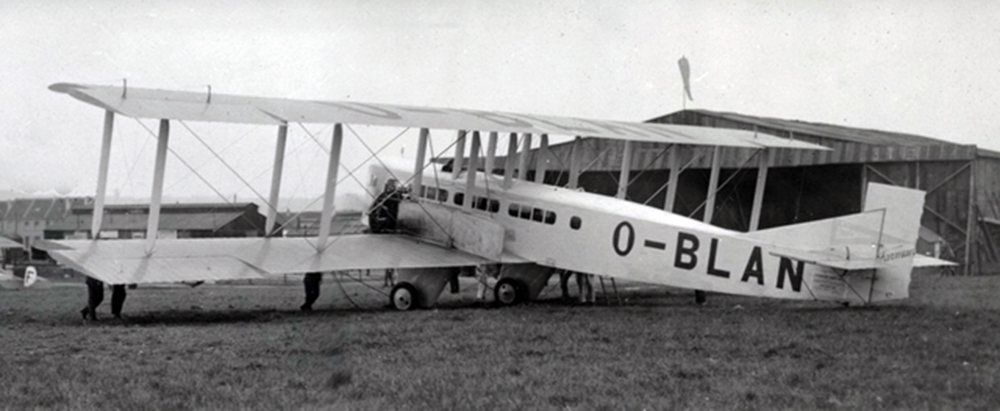
On 26 August 1921 a Farman F.60 Goliath operated by SNETA came down in the sea about three nautical miles off Calais. It was flying mail from London to Brussels. The aircraft was later recovered, but its two crew members, a pilot and a mechanic, were reported missing. It was the first accident involving the Goliath in civil service.
Key facts
| Date | 26 August 1921 |
| Aircraft | Farman F.60 Goliath, registration O-BLAN |
| Operator | SNETA |
| Route | Croydon Airport, United Kingdom, to Brussels, Belgium |
| Type of flight | |
| People on board | 2 (pilot and mechanic) |
| Outcome for crew | Both reported missing |
| Location | About 3 nautical miles off Calais, France |
Background
The Farman F.60 Goliath was a large twin-engined biplane that the French maker Farman designed towards the end of the First World War. After the war it was adapted for passenger and freight work. Several airlines used it on the busy routes between London, Paris and Brussels.
SNETA was a Belgian operator that opened a Brussels to London service in 1921. Its flights ran between Croydon, then London's main airport, and the Brussels area. The aircraft involved, O-BLAN, was one of the company's Goliaths. It was built in 1920 and carried the manufacturer's serial number 7248.
The crew that day were pilot Paul Delsenne, a French aviator who had flown in Belgian civil aviation for just over a year, and mechanic Raymond Rijckers. At the time, a mechanic normally flew with the pilot to look after the engines in flight.
The flight
O-BLAN left Croydon at 12:25 local time with a load of mail. The route led south-east across Kent and then over the Strait of Dover, the narrowest part of the English Channel, towards the French coast.
At 13:32, about an hour after departure, a gendarme on the French shore reported hearing an explosion. He then saw the aircraft break up and fall into the sea about three nautical miles (5.6 km) off Calais. He sent a telegram to Calais, and the message was passed on to the gendarmerie at Boulogne and Gravelines.
The accident was also seen from the sea by Herbert Sullivan, who was aboard the yacht Zola. The yacht carried a radio, and Sullivan sent a radiogram describing what he had seen. The South Eastern and Chatham Railway steamer Maid of Orleans picked up the message and relayed it to the General Post Office in London.
Search and recovery
Fishing boats, yachts and submarines were sent out to look for the aircraft. Wreckage was located about three nautical miles off the coast. Sullivan recovered a bag of mail, which was sent on to the authorities in Brussels.
Contemporary press reports said that the steamship Tregenna later sighted wreckage off the Belgian coast. This suggests the remains drifted with the tide and current along the coast after the aircraft came down. Both crew members were reported missing, and the newspapers of the following days described the mail as lost.
Accounts of what happened to the aircraft differ. One account says it was salvaged, repaired and returned to service. Another aviation database lists it as written off. The sources do not settle the question.
What is known about the cause
No official investigation report has been identified for this accident, so the cause is not established. The evidence is limited to the eyewitness account and the press reports of the time.
The gendarme's report of an explosion and of the aircraft breaking apart is the main piece of testimony. Some later summaries say there was a fire on board before the aircraft reached the sea. These are secondhand accounts, and they do not explain what started a fire or why the structure failed.
Descriptions of where it came down also vary. Some summaries place it in the North Sea. Most place it in the English Channel off Calais, which matches the position given by the witnesses. The Strait of Dover is the point where the Channel meets the North Sea, which probably explains the difference.
Legacy
The accident is mainly of interest as an early example of the risks of regular flying over water. Flights between London and the Continent in 1921 were made in open or lightly enclosed cockpits. They carried little navigation equipment, no lifejackets as standard, and no organised rescue arrangements. What happened to O-BLAN was seen from the shore and from a yacht, and the first alert reached London by radio and telegraph. The search that followed relied on whatever boats were nearby.
The Goliath went on to serve for years on Channel routes, and it later suffered further accidents under other operators. The loss of O-BLAN stands as the first civil accident involving the type, and it is one of the early cases in the history of cross-Channel air transport.