
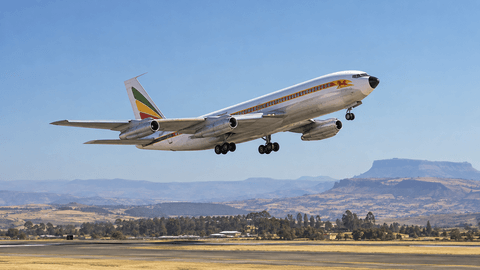
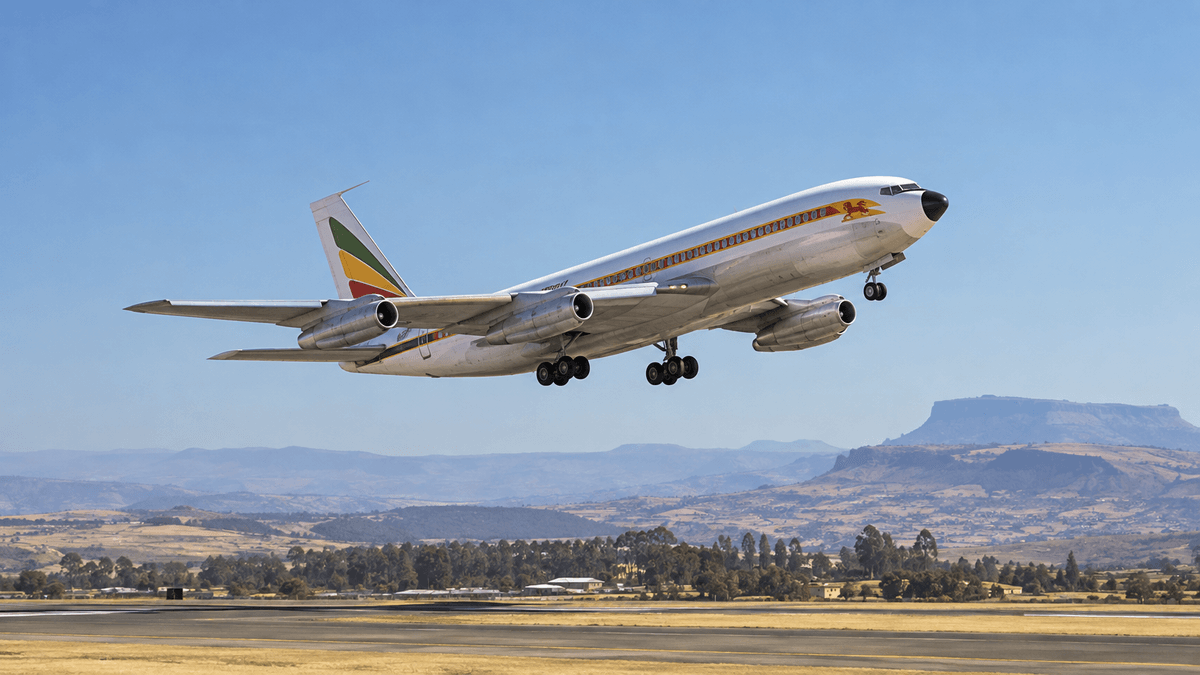
Ethiopian Airlines Flight 708: Hijacking Attempt, Addis Ababa, 1972
On 8 December 1972, an Ethiopian Airlines Boeing 720 had been airborne for only a few minutes when a group of armed passengers stood up and tried to take control. Armed security guards on board opened fire, and a grenade went off in the cabin. The crew turned back and landed at Addis Ababa. No passenger or crew member was killed, but all seven hijackers died.
Key facts
| Date | 8 December 1972 |
| Aircraft | Boeing 720-060B |
| Operator | Ethiopian Airlines |
| Planned route | Addis Ababa, Asmara, Athens, Rome, Paris |
| Departure airport | Haile Selassie I International Airport, Addis Ababa |
| Type of event | Attempted hijacking |
| Hijackers | Seven, all members of the Eritrean Liberation Front; all died |
| Outcome | Aircraft returned and landed at Addis Ababa; later repaired |
Background
The Eritrean Liberation Front was an armed movement fighting for Eritrean independence from Ethiopia. In that period, hijacking was one of several methods used by armed groups across the world to seize attention or force aircraft to fly to a chosen destination. Ethiopian Airlines had already seen an earlier flight diverted to Aden by members of the same group, so the risk was not new.
Flight 708 was a scheduled international service. It was to call at Asmara, Athens and Rome before ending in Paris. The Boeing 720 was a four-engine jet airliner, and on this flight it carried a number of armed security guards. One account puts the number at six.
The flight
The aircraft took off from Addis Ababa and climbed towards its cruising level. About 13 minutes after departure, with the aircraft at roughly 29,000 ft, seven passengers stood up. Accounts say they drew guns and shouted instructions in Amharic, the main working language of Ethiopia.
Sources disagree on the make-up of the group. Some say five men and two women, while others say six men and one woman. All agree there were seven.
The security guards opened fire. During the exchange, one of the hijackers armed a hand grenade. A passenger then picked it up and rolled or threw it along the aisle, away from the occupied seats. It exploded in the rear part of the fuselage, a short distance from the aircraft's centreline.
The blast made a hole in the cabin floor. It also damaged or severed several of the aircraft's flight controls. These included:
- the throttle controls for two of the engines, which set how much power each engine produces;
- the rudder, the hinged surface on the tail fin that steers the aircraft left and right;
- the horizontal stabiliser, the tailplane surface that helps control the nose-up and nose-down attitude.
Smoke filled the cabin. Despite the damage, the crew turned the aircraft round and flew back to the departure airport. They landed safely at Addis Ababa. The guards had killed six of the hijackers, and the seventh died later in hospital.
What is known about the aftermath
The aircraft's damage was repairable, and it was later returned to service. Reports from the time and later summaries describe the structural and control damage as significant for an aircraft in flight, yet the crew still kept it under control. That reflects the redundancy built into airliners: several control systems and engines meant that losing some did not leave the pilots without options.
Figures for the number of people on board vary between sources, and passenger lists are not given consistently. For that reason this article does not give a single total. Sources agree on the central outcome: the only deaths were those of the hijackers.
Investigation
This was a criminal act rather than an accident, so there was no conventional accident investigation of the kind that follows a crash. The record of the event rests mainly on contemporary press coverage, including a report in a leading aviation weekly the same month, and on later summaries compiled from those accounts. Because the accounts differ on details such as the make-up of the group and the number of occupants, it is safest to treat the broad sequence as established and the finer points as uncertain.
The sequence they agree on is simple. Armed passengers tried to take over the flight, guards on board fired on them, a grenade exploded in the cabin, and the crew returned to Addis Ababa.
Legacy
The incident belongs to a wave of hijackings in the early 1970s that pushed governments and airlines towards tighter security. Over the following years, passenger and baggage screening at airports became standard in many countries. Flight 708 is a reminder that the armed guards used on some routes at the time carried their own risks, since gunfire and explosives inside a pressurised aircraft can damage the structure and its controls.
It also shows the value of crew training and aircraft design. Even with a hole in the floor and damaged controls, the pilots flew a controlled return and landing. The flight is remembered less for what the hijackers achieved, which was nothing, than for the way the aircraft and its crew coped with the aftermath.