
Japan Airlines Flight 813: Engine Failure, San Francisco, 1965
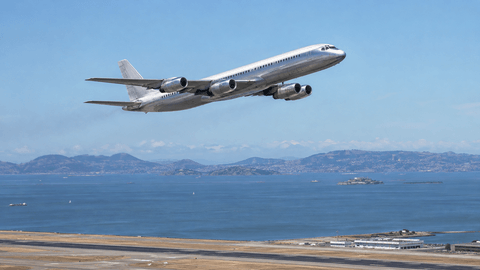
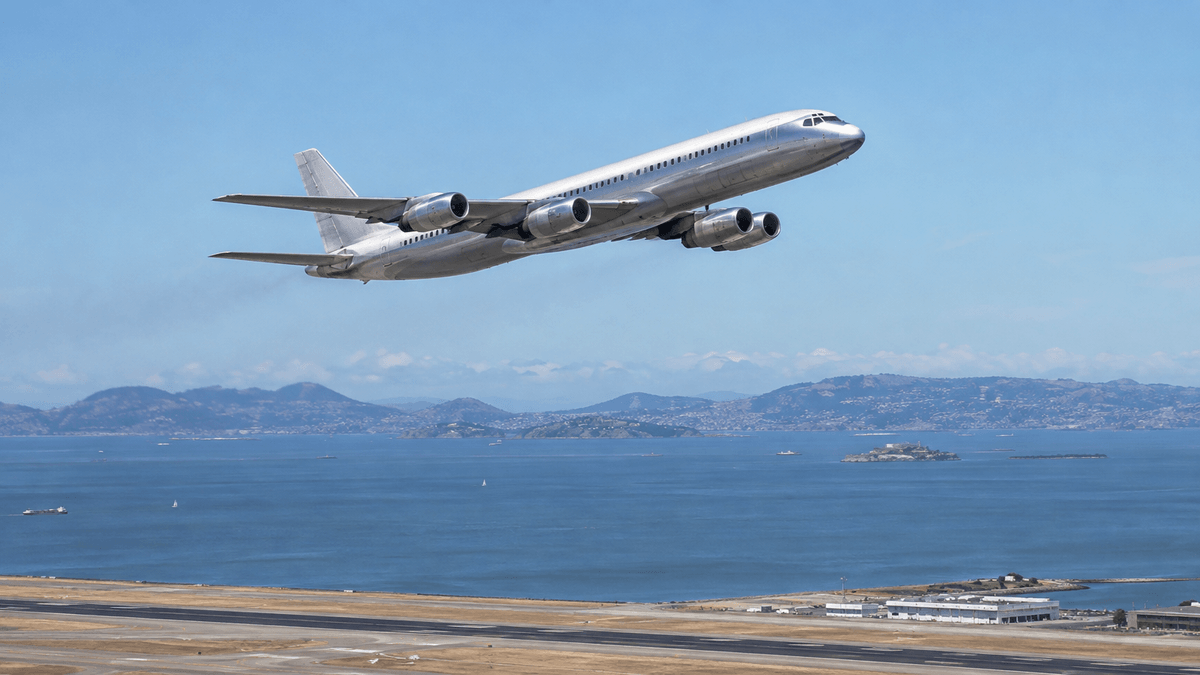
On Christmas Day 1965, a Japan Air Lines Douglas DC-8 climbed out of San Francisco bound for Honolulu and Tokyo. Three minutes into the climb, its number one engine broke apart and caught fire. The crew diverted across San Francisco Bay and landed at Oakland. Everyone on board survived without injury. The investigation traced the failure to the way a component had been secured during an engine overhaul.
At a glance
- Date: 25 December 1965
- Aircraft: Douglas DC-8-33, registration JA8006, named Kamakura
- Operator: Japan Air Lines
- Route: San Francisco International Airport to Haneda Airport, Tokyo, with a stop at Honolulu
- People on board: 41 (31 passengers and 10 crew)
- Fatalities: 0
- Injuries: none reported
- Investigation: United States Civil Aeronautics Board
Background
The aircraft and its engine
JA8006 was built in 1961 and had flown a little over 13,400 hours. It had four Pratt & Whitney JT4A-9 turbojet engines.
The number one engine, on the far left of the wing, had recently been overhauled at the airline's workshop in Tokyo in August 1965. Inspectors found fatigue cracks in the torque ring of its low-pressure compressor, which is the front section of the engine that draws in and compresses air. The ring was replaced. The engine was fitted to JA8006 on 20 November 1965 and returned to service on 24 December, the day before the accident.
The crew
The flight deck crew was Captain Tsuneo Kato, First Officer Shinsuke Jinnaka, flight engineer Harold Brown and navigator Susumu Kohno. All were experienced. The captain had more than 8,000 flying hours, including 909 on the DC-8. Four of the ten crew members were deadheading, meaning they were travelling as passengers to position for later duties rather than working the flight.
The flight
Flight 813 took off from Runway 01 at San Francisco at 13:08 Pacific Standard Time (21:08 UTC). At 13:11 the aircraft was climbing at 270 knots through about 4,500 ft when the number one engine suffered what is called an uncontained failure. This means that broken internal parts break through the engine casing instead of being held inside it.
The aircraft shook strongly and rolled to the left. The pilots carried out the engine failure checklist straight away, and the vibration eased. A fire had started in the engine, but the engine could not be seen from the cockpit and no fire warning sounded. The crew learned of the fire from a flight attendant.
Within about a minute the captain declared a mayday, the international distress call, and asked to land. By then it was becoming harder to control the aircraft sideways, and hydraulic pressure, which powers the flight controls, was falling.
The crew considered turning back to San Francisco. At 13:16 the captain chose instead Runway 29 at Metropolitan Oakland International Airport, which offered a more direct approach. The DC-8 landed there at 13:20, about twelve minutes after take-off. None of the 41 people on board was hurt.
The investigation
The Civil Aeronautics Board, then responsible for investigating civil aircraft accidents in the United States, examined the aircraft and the engine. The damage was considerable. The engine had been wrecked by the failure and the fire that followed. Flying debris had torn away nearly half of the left aileron, the hinged surface on the wing that helps the aircraft roll. It had also damaged hydraulic lines and the pylon, the structure that attaches the number two engine to the wing. These findings fit the loss of roll control and falling hydraulic pressure that the crew experienced.
The board concluded that the probable cause was the disintegration of the engine and an in-flight fire. These resulted from maintenance staff not properly securing the torque ring in the low-pressure compressor during the overhaul. The investigation did not point to any fault in the crew's handling of the emergency.
Legacy
The aircraft was repaired and returned to service. The accident is a reminder that an engine can fail soon after entering service if one component is not correctly fitted during overhaul. It also shows how much depends on the first minutes after such a failure. In this case the crew:
- followed the engine failure checklist immediately
- declared an emergency early
- kept control of the aircraft despite the damage to the wing and hydraulics
- chose the nearer airport that offered the most direct approach
Captain Kato's decision to continue to Oakland, instead of turning back to the departure airport, was part of why the flight ended without injury.