
Air India Flight 171: Loss of Thrust after Take-off, Ahmedabad, 2025
On 12 June 2025 an Air India Boeing 787-8 crashed 32 seconds after taking off from Ahmedabad, western India, bound for London Gatwick. Of the 242 people on board, one survived. Nineteen people on the ground also died. It was the first fatal accident, and the first hull loss (an aircraft damaged beyond economic repair), involving a 787 since the type entered service in 2011. India's Aircraft Accident Investigation Bureau (AAIB) leads the investigation.
At a glance
| Date | 12 June 2025 |
| Aircraft | Boeing 787-8 Dreamliner, registration VT-ANB |
| Route | Ahmedabad, India, to London Gatwick, England |
| People on board | 242 (230 passengers, 12 crew) |
| Fatalities | 241 on board, 19 on the ground |
| Investigation | AAIB (India); preliminary report published 12 July 2025 |
Background
The aircraft and the route
VT-ANB was delivered to Air India in January 2014 and had flown about 41,868 hours. It had two General Electric GEnx-1B70 engines, both installed less than three months before the accident. Air India had flown to Gatwick since 2023 and operated five departures a week from Ahmedabad.
The people on board
The 230 passengers included 169 Indian, 53 British, 7 Portuguese and 1 Canadian citizens. Thirteen were children, two of them infants. The captain had about 15,600 flying hours, of which nearly 8,600 were on the 787. The first officer had about 3,400 hours, with around 1,100 on the type. The first officer was the pilot flying, meaning the one handling the controls. The captain was the pilot monitoring, who checks the flight and handles radio calls.
The flight
The aircraft crashed at about 13:39 India Standard Time (08:09 UTC). According to the preliminary report, it reached a maximum recorded airspeed of 180 knots shortly after lift-off. Within seconds, the two engine fuel control switches on the centre console moved from RUN to CUTOFF, one after the other, about a second apart. These switches open and close the fuel supply to each engine, so both engines began to lose thrust.
The cockpit voice recording captured one pilot asking the other why the fuel had been cut off. The other replied that he had not done so. The preliminary report did not say which pilot spoke which line.
The switches were then returned to RUN, and the engines started to relight. The ram air turbine, a small emergency turbine that drops into the airflow to supply hydraulic and electrical power, deployed. One pilot transmitted a Mayday call. Air traffic control asked for the aircraft's call sign but received no reply.
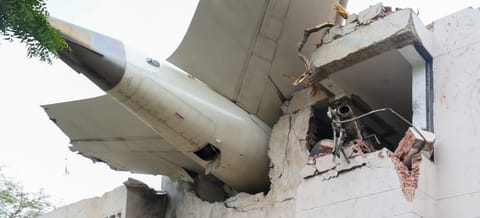
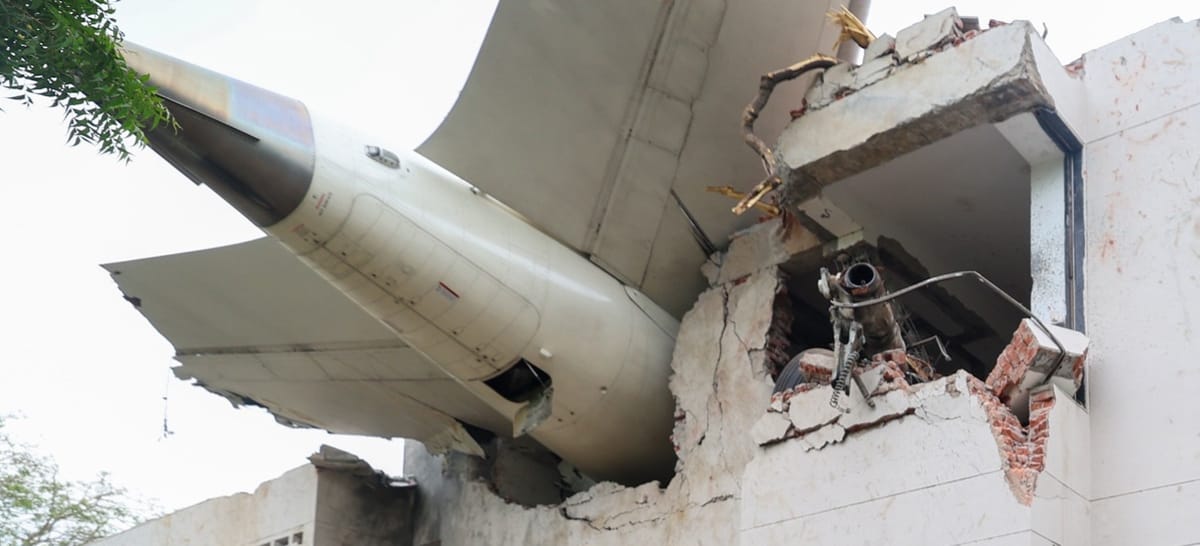
The aircraft did not have enough height for the engines to recover. It came down about 1.7 km (0.9 nautical miles) from the runway, striking student hostel buildings of the B. J. Medical College. Several buildings were badly damaged by the impact and the fire that followed.
The investigation
The AAIB is working with accredited representatives from the states of registry, operator, design and manufacture, as required by ICAO Annex 13, the international standard for accident investigation. The data came from the front enhanced airborne flight recorder. This unit combines the flight data and cockpit voice recordings in a single device.
The preliminary report, a 15-page document, set out what happened rather than why. It reported that the pilots tested negative for intoxicating substances before the flight. The aircraft's weight was within limits, and the report did not identify fuel contamination. At that stage it made no recommendations to Boeing or General Electric. It also noted an earlier US Federal Aviation Administration advisory. That advisory, prompted by reports on Boeing 737s, concerned fuel switches found installed with their locking feature disengaged.
The report did not explain how the switches moved. Officials in India and the US National Transportation Safety Board urged against drawing conclusions from the preliminary report alone. The AAIB said the final report would give root causes and recommendations.
Legacy and current status
Because no final report has been published, there are no formal causal findings or recommendations yet. Some practical consequences have followed:
- India's civil aviation regulator ordered additional maintenance checks on Air India's 787 fleet.
- Air India retired flight numbers AI171 and AI172. It now uses AI159 and AI160 on the Ahmedabad–Gatwick route.
- The case has renewed public debate about who should have access to cockpit recordings during an investigation. The AAIB has told the Supreme Court that disclosing such material is prohibited by statute.
Petitioners, including a relative of one of the pilots, have asked the Supreme Court of India for an independent, court-monitored inquiry. The AAIB told the court that it had run several simulations and expected its draft final report to be ready in October 2026. It has said the final report will be released after the international review and consultation that Annex 13 prescribes.
Where the case stands
The established facts are narrow but significant. Both engines lost fuel supply within seconds of take-off, and the crew did not have the height or time to recover. The AAIB's final report has to explain why the fuel control switches moved. That explanation will matter for the families, for Air India, and for crews and manufacturers elsewhere. Until the report is published, it is more accurate to say the cause is unresolved than to rely on speculation.