
Delta Air Lines Flight 9570: Wake Turbulence, Fort Worth, 1972
On the morning of 30 May 1972, a Delta Air Lines McDonnell Douglas DC-9 was making a training approach to Greater Southwest International Airport, near Fort Worth, Texas. On final approach it rolled sharply to the right and struck the runway. The four people on board died. The investigation traced the loss of control to the wake of a larger jet that had landed just ahead, and the findings changed the way air traffic is spaced.
| Date | 30 May 1972 |
| Aircraft | McDonnell Douglas DC-9-14, registration N3305L |
| Route | Dallas Love Field, with training approaches at Greater Southwest International Airport, Fort Worth, and a return to Dallas planned |
| People on board | 4 (a two-pilot flight crew, a third pilot awaiting his check, and an FAA inspector) |
| Fatalities | 4 |
| Investigation | National Transportation Safety Board (NTSB), report NTSB-AAR-73-3 |
Background to the flight
Flight 9570 was not a passenger service. It was a check flight, intended to assess the proficiency of three Delta pilots. The aircraft was a DC-9-14 built in 1965, which had flown just under 19,000 hours.
Two pilots were operating the aircraft. A third pilot, waiting for his own check, was expected to ride in the cabin. An FAA air carrier operations inspector sat on the jump seat, the fold-down seat between and behind the two pilots, observing the proficiency checks.
Greater Southwest International Airport was well suited to this kind of work, as it had little traffic. On the same morning an American Airlines DC-10 was also using it for training, flying repeated touch-and-go landings. In a touch-and-go, the aircraft lands and takes off again without coming to a stop. The DC-10 was unaffected by the accident.
The flight
Flight 9570 left Dallas Love Field at 06:48 Central Daylight Time (11:48 UTC). At Fort Worth it requested an ILS approach to Runway 13. The ILS, or instrument landing system, is a radio guidance system that leads an aircraft down a fixed path to the runway. The crew was told that the DC-10 was already in the circuit. The first landing was uneventful.
The crew then flew further training manoeuvres, including a missed approach, and asked to land again on Runway 13, behind the DC-10. The controller cleared them to land and added a caution about turbulence. The controller did not use the word "heavy", the category for the largest jets, although the DC-10 had been named as the preceding traffic.
On final approach the DC-9 began to oscillate in roll, then rolled rapidly to the right. After turning through about 90 degrees, its right wingtip struck the runway. The aircraft continued to roll until the fuselage hit the ground almost inverted. Impact forces damaged it and a fire destroyed it. The accident occurred at about 07:24 local time.
The investigation
Testing the hypothesis
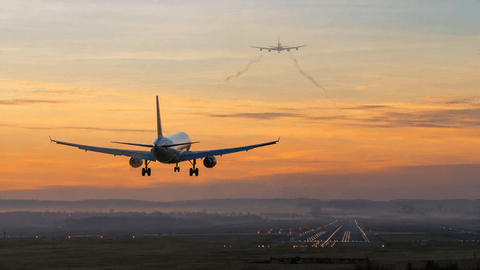
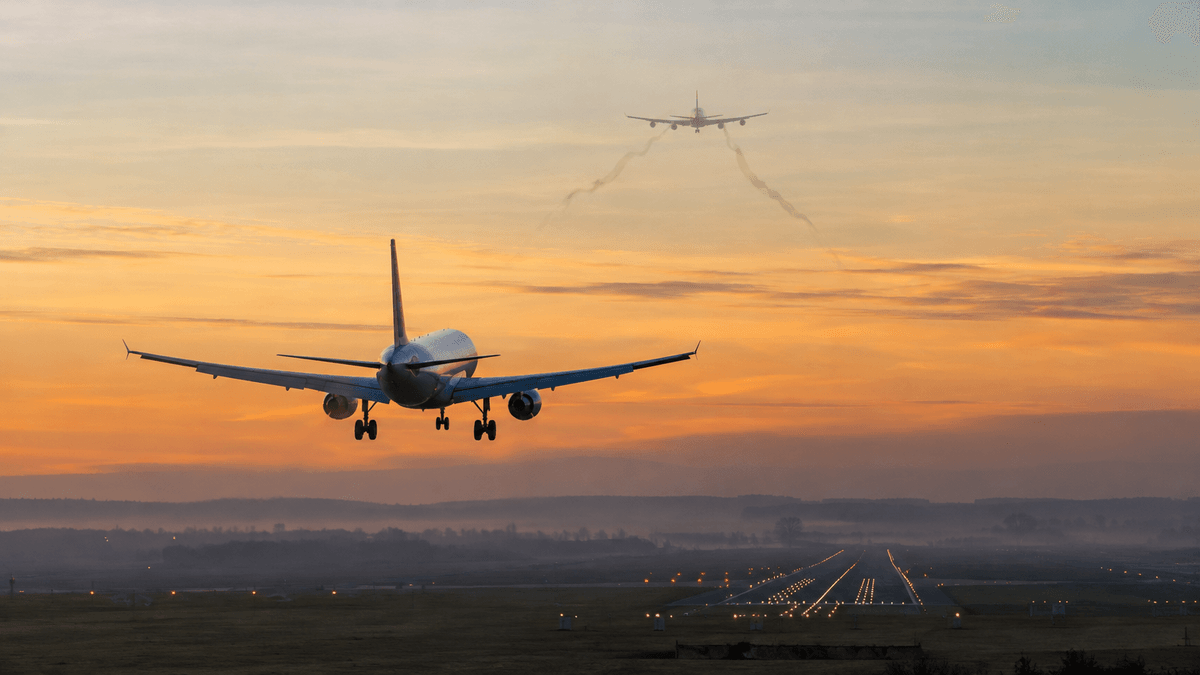
The way the aircraft rolled suggested to the NTSB that it had met wake turbulence. This is the disturbed air a wing leaves behind it, in the form of two rotating tubes of air called trailing vortices. They can persist for a minute or more after the aircraft has passed. Most known wake-turbulence accidents until then had involved aircraft smaller than the DC-9, so the investigators tested the idea rather than assume it.
They released coloured smoke from the control tower and watched how it behaved as a similarly sized wide-body jet flew past, to see how long vortices lasted. Their tests showed that the wake of an aircraft the size of the DC-10 could upset a following DC-9 by as much as happened to Flight 9570. Flight recorder data showed that the DC-9 had followed the same track as the DC-10 on its final approach. It stayed above the wake until inside the middle marker, a beacon on the approach path. It then descended into the disturbed air from the DC-10's left wingtip.
Probable cause
The NTSB, in its report of 13 March 1973, found that the probable cause was an encounter with a trailing vortex from a preceding heavy jet, which caused an involuntary loss of control during final approach.
The Board also looked at why the crew might not have recognised the risk. It noted that they had been cautioned to expect turbulence but lacked enough information to judge the hazard or where the vortex lay. It observed that experienced pilots, and the FAA inspector in particular, should have known that the DC-10 fell into the heavy category and that a two-minute spacing applied in instrument conditions. It also suggested that the crew may have been absorbed in following the approach procedures in the Delta operating manual, which they followed closely. The Board added that FAA procedures for visual flight did not give the same protection against vortices as those for aircraft under radar control.
Legacy
The accident showed that medium-sized airliners, and not only light aircraft, could be upset by the wake of the new wide-body jets, which were entering service in growing numbers.
- The NTSB issued recommendations on 30 June 1972, asking the FAA to reassess separation criteria behind heavy jets, and made further recommendations later in the year.
- On 28 July 1972 the FAA issued special instructions to controllers, requiring greater spacing behind the DC-10 and the Lockheed L-1011 TriStar.
- The FAA went on to classify aircraft by weight and set minimum separations on that basis. Under the rules that followed, an aircraft lighter than a heavy keeps at least five nautical miles behind one, and a heavy behind another heavy keeps four.
- Wake-turbulence warnings and pilot training were strengthened, with more emphasis on the responsibility of pilots who accept a visual approach behind a larger aircraft.
The weight-based categories and the habit of calling large jets "heavy" on the radio remain part of air traffic control today.