
Emirates SkyCargo Flight 9788: Runway Excursion, Hong Kong, 2025
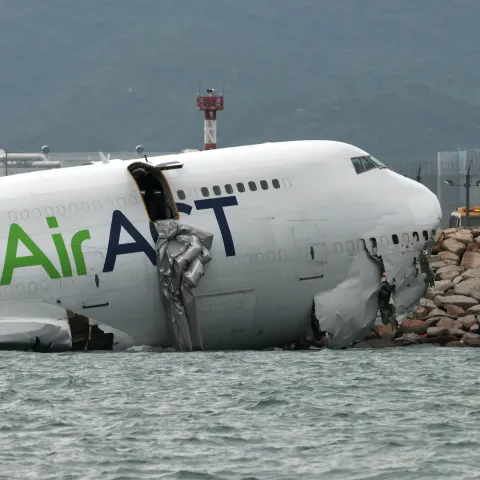
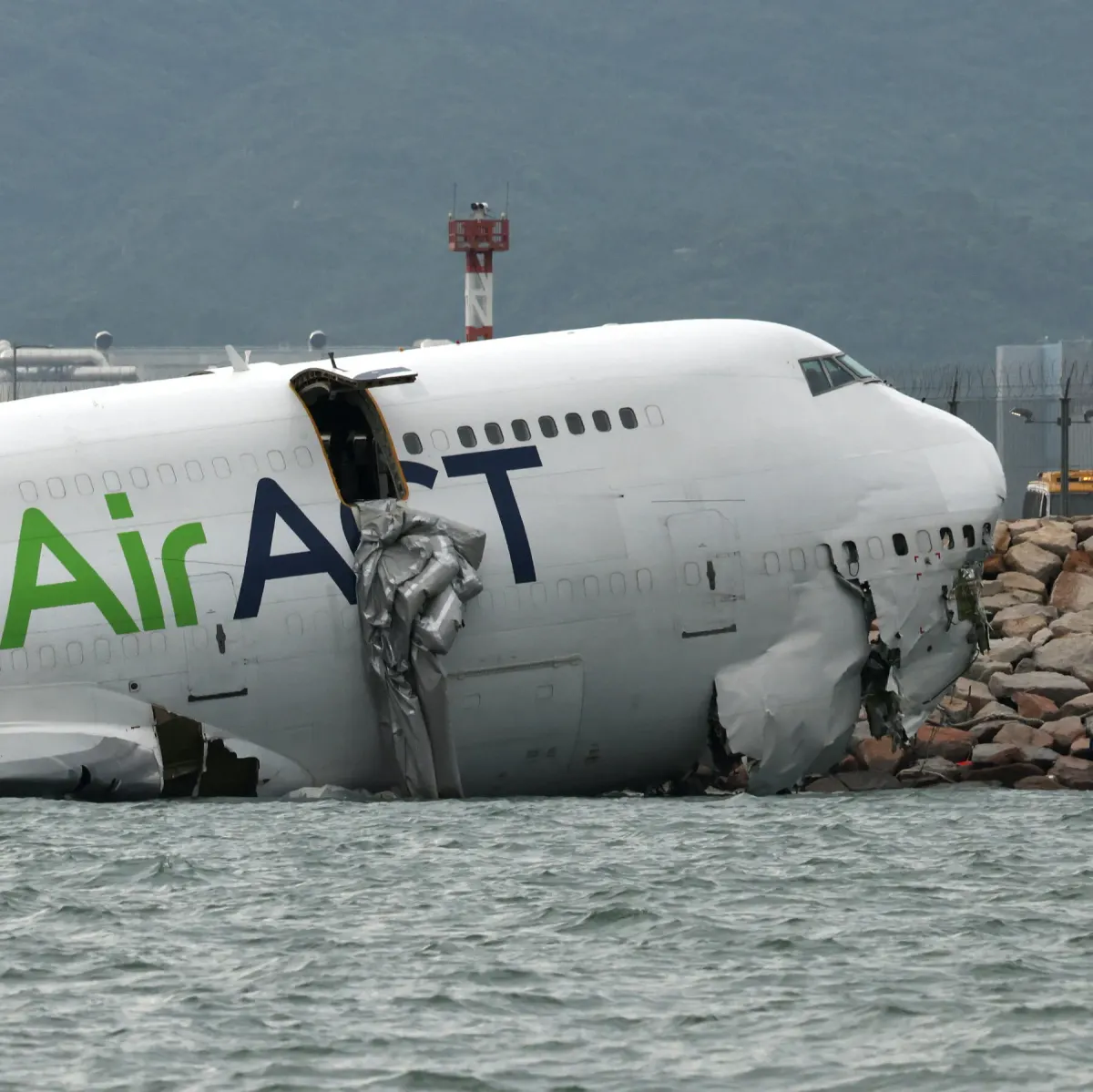
In the early hours of 20 October 2025, a Boeing 747 freighter landed at Hong Kong International Airport, veered off the left side of the runway and came to rest in the sea. All four crew members survived. Two airport security staff in a vehicle outside the runway area died. This article summarises what is publicly known, based on the investigation's published material.
Key facts
| Date | 20 October 2025 |
|---|---|
| Aircraft | Boeing 747-481BDSF, registration TC-ACF |
| Operator | ACT Airlines (Air ACT), for Emirates SkyCargo |
| Route | Al Maktoum International Airport, Dubai, to Hong Kong International Airport |
| People on board | 4 (all crew), no cargo carried |
| Fatalities | 2 on the ground, 0 on board |
| Investigation | Air Accident Investigation Authority (AAIA), Hong Kong; preliminary report PLR-2025-04, interim statement ITR-2026-09 |
The aircraft and the operation
TC-ACF was built in 1993 and first flew as a passenger aircraft for All Nippon Airways. It was converted to a freighter in 2011 and joined Air ACT, a Turkish cargo carrier, in 2013. It had four General Electric CF6-80C2B1F engines. Emirates SkyCargo had hired the aircraft and crew from Air ACT, an arrangement known as a wet lease. Emirates later confirmed that no cargo was on board.
The aircraft left Dubai on 19 October at about 17:00 local time (about 13:00 UTC). Take-off and cruise were uneventful.
Before departure, the aircraft was dispatched with the thrust reverser on its number 4 engine, the outer right-hand engine, inoperative. A thrust reverser redirects engine power forwards to help slow the aircraft after landing. The Minimum Equipment List permits flight with certain items out of service. This is the approved list of equipment that may be inoperative, within set limits. The AAIA's preliminary report recorded that this item was one of those allowed.
The landing
The aircraft touched down on runway 07L at 03:52 Hong Kong time on 20 October (19:52 UTC on 19 October). Weather was suitable, with visibility above 10 km. The first officer was flying and the captain was monitoring. Flight data showed a normal touchdown at 03:52:13.
The crew extended the speed brake lever and selected reverse thrust on engines 2 and 3, with engine 1 at idle reverse. Soon afterwards an AUTOBRAKES message appeared on the crew alerting display. The autobrake system, which applies wheel braking automatically, had disarmed. The crew called for manual braking.
The flight data recorder then showed the number 4 engine accelerating in forward thrust. It reached 90% of N1 at 03:52:30. N1 is the rotational speed of the engine's front fan, expressed as a percentage of a reference value, and it is a common measure of thrust. The selected reversers were stowed at 03:52:35. The number 4 engine went on to about 106% N1 and then 107% N1 at 03:52:42. Reverse thrust was selected again on the other engines, but the aircraft had begun to turn left.
The aircraft left the runway about abeam taxiway C6. It crossed the airport perimeter, damaging a fence, signage and weather sensors, and struck an airport security vehicle. It came to rest in the sea, with its tail section separated from the rest of the fuselage. The aircraft was destroyed. The Fire Services Department was alerted at about 03:55 and began rescue operations within minutes. More than 200 firefighters and ambulance personnel took part, with vehicles, vessels and a helicopter.
The investigation
The AAIA leads the investigation. Turkey's Transport Safety Investigation Center, the US National Transportation Safety Board and Boeing have taken part. The AAIA published its preliminary report on 18 November 2025. It set out the facts and did not state a cause.
The AAIA published an interim statement on 13 October 2026. Hong Kong's rules follow ICAO Annex 13, which requires an interim statement on each anniversary when a final report is not yet available. The statement says the forward movement of the number 4 thrust lever caused the aircraft to turn left and leave the runway. Investigators are working to establish whether the lever was driven mechanically or moved by external forces.
The AAIA reports that analysis of the flight data, cockpit voice and quick-access recorders has so far found no aircraft anomalies. It also reports that specialist examination of the engine control computers and other components found nothing relevant to the accident. Components, including the recorders, were sent to the state of manufacture for examination. The AAIA expects to complete the investigation by the end of 2026.
What has changed so far
No final report has been published, so no probable cause has been stated and no formal safety recommendations are available yet. Two developments are on record:
- In April 2026 Boeing published a reminder to all 747 operators. It covers the guidance in the flight crew manuals on crew callouts and on handling thrust levers and reversers during landing.
- Runway 07L was declared fit for use after inspection and returned to service. Three runways were in operation, and the other two stayed open on the day.
Airport Authority Hong Kong confirmed the deaths of the two security staff and offered condolences. This was the first fatal aviation accident at the airport since China Airlines Flight 642 in 1999. The final report should explain why the number 4 thrust lever moved forward and what part the autobrake message played.