
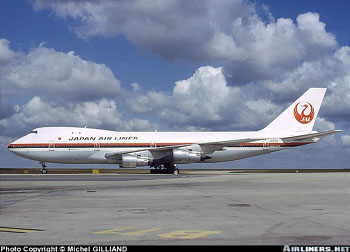
Japan Air Lines Boeing 747: Food Poisoning Outbreak, Copenhagen, 1975
On 3 February 1975 a Japan Air Lines Boeing 747 approached Copenhagen with a large share of its passengers suddenly unwell. Nearly 200 people had developed vomiting and abdominal pain, and 144 were taken to hospital after landing. It remains the largest recorded outbreak of food poisoning on board a commercial airliner. Nobody died as a result of the illness, and the investigation that followed is still used as a teaching case in food safety.
- Date: 3 February 1975
- Aircraft: Boeing 747-246B, Japan Air Lines
- Route: Tokyo to Paris, with stops at Anchorage and Copenhagen
- Cause: Staphylococcus aureus toxin in ham served at breakfast
- Hospitalised: 144
The flight and its passengers
The aircraft was on a charter service from Tokyo to Paris. Most of the 344 passengers were Japanese sales staff of a soft-drinks company and their family members, who had won the trip as a prize. Twenty crew were on board. The routing included a technical and catering stop at Anchorage International Airport, Alaska, and a second stop at Copenhagen.
At Anchorage, the meals for the next sector were loaded. They had been prepared by International Inflight Catering, a company based in the city and owned in part by the airline. The meal service for the leg to Copenhagen included a breakfast of cheese omelettes topped with sliced ham.
Illness over Denmark
About an hour after breakfast, as the aircraft neared Copenhagen, passengers began to be sick. Symptoms included vomiting, diarrhoea and abdominal cramps. The illness came on quickly, which later proved to be an important clue. Reports differ slightly on the totals: a US public health bulletin counted 196 people ill, and the figure for those admitted to hospital in Denmark is given as 144, including one flight attendant.
Everyone admitted stayed in hospital at least overnight, and around 30 were reported in the press as needing intensive care. The remaining passengers continued to Paris. Communication was a practical problem, because none of the doctors spoke Japanese and few passengers spoke Danish or English. Japanese-speaking staff from Copenhagen restaurants were brought in to interpret.
The investigation
Laboratory findings
A team in Anchorage, led by a US Public Health Service physician from the Alaska State Health Department, worked with Danish colleagues to find the cause. Samples of stool and vomit from passengers were tested, along with 33 samples of leftover ham omelettes. All showed Staphylococcus aureus, a common bacterium that can release toxins into food. The ham also held a high level of toxin, which accounted for the short interval between eating and falling ill.
Tracing the source
Investigators went back to the Anchorage kitchen. Three cooks had prepared the meals. One had infected sores on two fingers of his right hand. Samples from the sores and from the food matched in their phage type (a laboratory fingerprint of a bacterial strain) and in their resistance to antibiotics. This pointed to the cook's hand as the source of the contamination.
The investigators reported that the cook had bandaged the sores and had not mentioned them to his supervisor, as he thought them minor. They also found that management had not checked his health, although it was required to do so.
Who ate what
The aircraft had four galleys and served 364 meals: 40 in first class and 108 from each of three main-deck galleys. The cook concerned prepared all 40 first-class omelettes, 72 of the 108 for one main-deck galley and all 108 for another. In total he handled 220 meals. On the investigators' reasoning, the 144 people served from the other sources were unlikely to have eaten contaminated food. Sources differ on exactly who placed the ham on one batch of omelettes, so the figure is best read as an estimate.
Why the bacteria thrived
Microbiologists note that a small number of staphylococci, perhaps as few as 100, can start a problem if the food lets them multiply. The way these meals were stored gave them that chance. They stood at room temperature in the kitchen for about six hours. They were then chilled for roughly 14½ hours, but at about 10 °C (50 °F), which is too warm to stop bacterial growth. After that they went into the aircraft ovens.
Heating did not make the food safe. The toxins produced by Staphylococcus aureus resist heat, so warming the omelettes killed bacteria but left the poison in place. This is why the outbreak could occur even though the food was served hot.
What the case teaches
The outbreak was reported in the US Centers for Disease Control's weekly bulletin within days and later in a scientific paper, and it has been cited since in discussions of airline catering. Its lessons are simple and still current:
- Food handlers with infected skin lesions should be taken off food preparation, whether or not they feel the sores are serious.
- Employers need to check, and not assume, that staff are fit to handle food.
- Prepared meals must be kept cold enough, for the whole waiting period, to stop bacteria growing.
- Reheating cannot be relied upon to remove toxins that are already in the food.
The case also shows how medical problems on a long flight can overwhelm a single destination. Hospitals, interpreters and local health authorities all had to respond within hours of landing, which is one reason airports and airlines plan for large-scale medical events.