
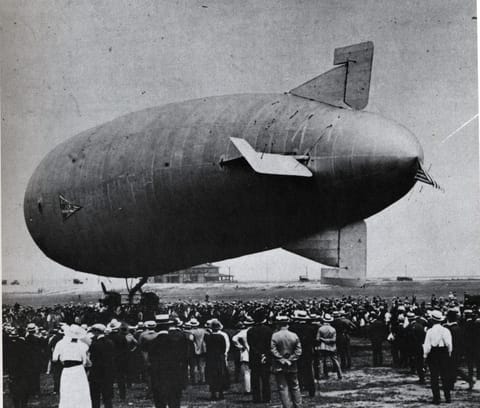
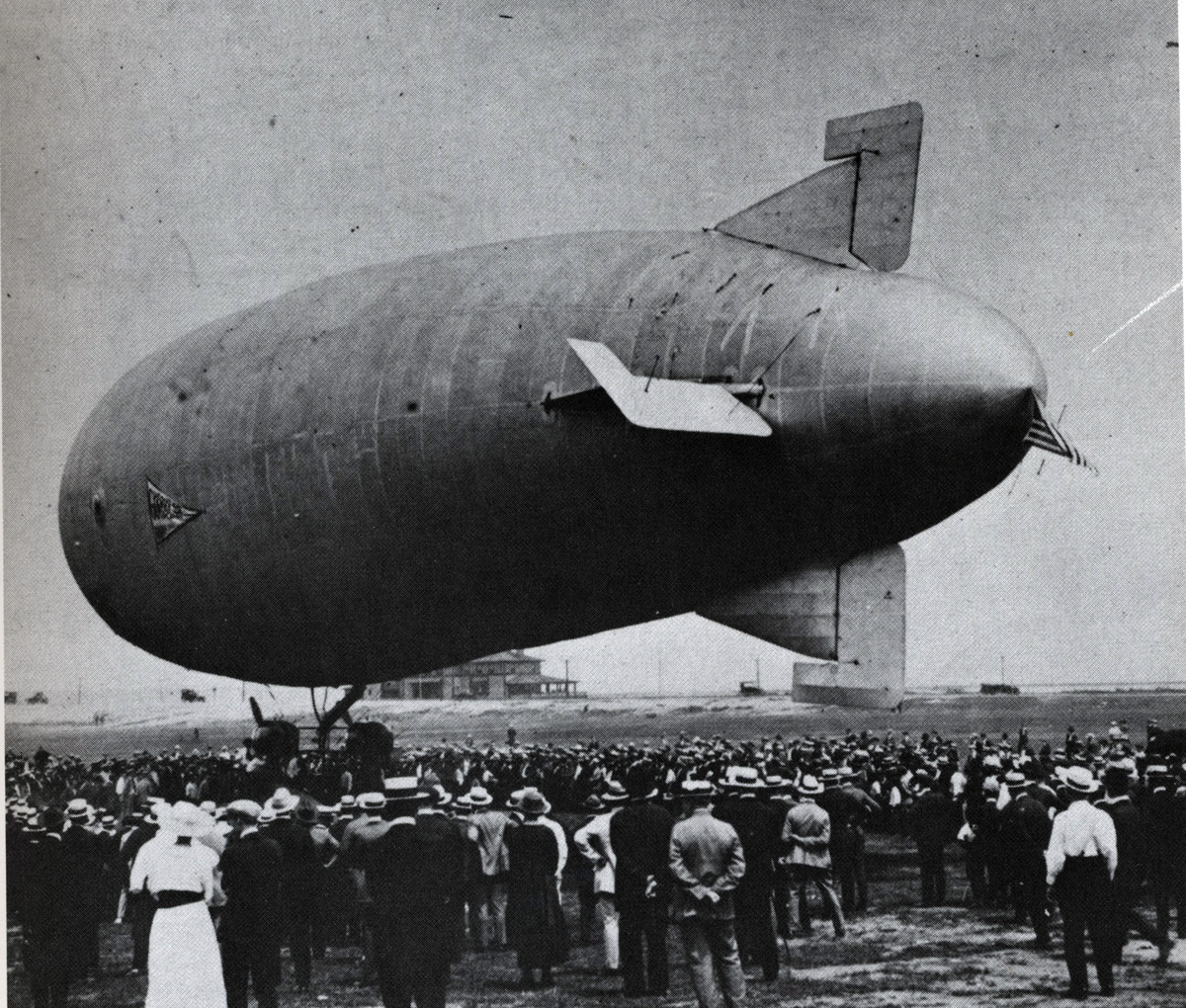
Wingfoot Air Express: Airship Fire over Chicago, 1919
On the afternoon of 21 July 1919, a Goodyear airship carrying passengers across Chicago caught fire at about 1,200 ft above the city centre. The burning wreckage fell into the Illinois Trust and Savings Bank, where staff were finishing the working day. Thirteen people died, and 27 more were injured. At the time it was the worst airship accident in the United States.
Fact file
| Date | 21 July 1919 |
| Aircraft | Goodyear Type FD airship, named Wingfoot Air Express |
| Operator | Goodyear Tire and Rubber Company |
| Route | Grant Park, Chicago, to White City amusement park, Chicago |
| People on board | 5 (3 crew, 2 passengers) |
| Fatalities | 13 (3 on board, 10 on the ground) |
| Injuries | 27, all on the ground |
| Cause | Fire in flight; the ignition source was never established |
Background
The Wingfoot Air Express was a blimp, meaning a non-rigid airship. It has no internal frame, and the gas inside its envelope, the large fabric bag, gives it its shape. Goodyear built and owned the craft. In the summer of 1919 the company was using it to carry paying passengers from Grant Park on the lakefront to White City, an amusement park on the South Side, as a trial of short-hop passenger flying.
The airship was filled with hydrogen. Hydrogen is light and widely available, but it burns very readily. Helium, which does not burn, was scarce and expensive at the time. Modern Goodyear blimps use helium.
The flight
The airship left Grant Park on a Monday afternoon with five people on board. They were the pilot, Jack Boettner, a chief mechanic, a second mechanic, a publicity agent for the amusement park and a newspaper photographer. Accounts differ on whether the route over the Loop, Chicago's central business district, was planned or was a detour for the photographer.
At about 16:55 local time, while the airship was cruising at roughly 1,200 ft over the Loop, the hydrogen caught fire. It is not known what ignited it. As it became clear that the craft was failing, the occupants used the parachutes they were carrying. The pilot and the chief mechanic reached the ground safely. Three of the five people on board did not survive.
The bank
The Illinois Trust and Savings Bank stood at the north-east corner of LaSalle Street and Jackson Boulevard. About 150 employees were closing for the day in and around the main banking hall. A large skylight lit the hall.
The burning remains of the airship struck the skylight and passed through it, and flaming debris fell into the hall below. Ten bank employees died and 27 were injured. Some early press reports gave slightly different counts. The totals above are the ones most widely used today.
The accident is often described as the first in which an aircraft crash killed a significant number of people on the ground.
The investigation
No formal accident report of the modern kind exists for this event. Aviation in 1919 had no national investigating body, and there was no established method for examining wrecks. Accounts of the period record that an inquiry began the day after the crash, but it did not reach a firm conclusion.
What can be said is limited. The envelope was filled with a flammable gas, the fire began in flight, and the ignition source was not identified. Static electricity and sparks from the engines are the kinds of causes commonly discussed for hydrogen fires, but the surviving record does not settle the question.
Legacy
The crash changed how Chicago treated flying over its streets.
- The city council went on to adopt a new set of rules for aviation over Chicago.
- The Grant Park airstrip, close to the Loop, was closed.
- A new field, Chicago Air Park, was created further from the centre. It is now Midway Airport.
- Plans for passenger airship services over the city lost momentum.
The accident also gave early lasting evidence of a principle that aviation regulators now treat as basic. Aircraft operating over crowded areas put people on the ground at risk, so routes, altitudes and the choice of lifting gas have to be judged with those people in mind.
Looking back
The Wingfoot Air Express crash is less well known than the airship accidents of the 1930s, but it came first, and it happened in the middle of a major city. The cause of the fire was never established. The accident did show the cost of flying a hydrogen-filled craft over a crowded district, and it led Chicago to move flying away from its centre.