
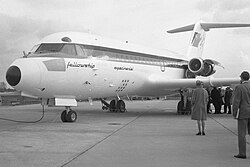
Braathens SAFE Flight 239: Approach to Fornebu, Norway, 1972
On 23 December 1972 a Braathens SAFE Fokker F28 Fellowship, arriving from Ålesund, struck forested hills in Vestmarka, Asker, while on approach to Oslo's Fornebu airport. Forty of the 45 people on board died. The investigation concluded that a navigational error, in combination with a known weakness in the approach guidance, had left the crew unaware of where they were.
Key facts
| Date | 23 December 1972 |
| Aircraft | Fokker F28 Fellowship 1000, registration LN-SUY, named Sverre Sigurdsson |
| Route | Ålesund Airport, Vigra, to Oslo Airport, Fornebu |
| People on board | 45 (42 passengers, 3 crew) |
| Fatalities | 40 |
| Survivors | 5 |
| Type of accident | Controlled flight into terrain |
Background
Braathens SAFE was the launch customer for the F28, a twin-engined short-haul jet. Sverre Sigurdsson was the first F28 to enter revenue service, in early 1969, and by 1972 the airline operated six of the type. LN-SUY had flown 8,228 hours and completed 16,710 flights at the time of the accident. The airline had met some operating difficulties as an early user of the type, but the investigation did not find a technical fault in this aircraft.
The flight was a scheduled service of about 45 minutes. It was the day before Christmas Eve, so many passengers were travelling home or heading abroad for the holiday. The captain had been with the airline for sixteen years, the last ten as captain. Only one cabin crew member was carried.
The approach to Fornebu
Runway 06 at Fornebu was served by an instrument landing system (ILS), which sends radio beams that guide an aircraft down to the runway. The standard procedure was to fly to a waypoint called RUMBA, make a left turn of about 15 degrees for roughly half a minute, and then intercept the ILS beam. The aircraft would be lined up with the runway at about 3,500 ft.
In clear weather, pilots often took a short-cut to reach the final approach path sooner. This had a hazard. Because of the surrounding terrain, the ILS beams could deviate by up to 25 degrees, which could tempt a crew to turn too early and fly towards high ground on the wrong heading. The problem was known, and pilots were expected to cross-check their position against the radio beacon at Asker.
The flight
Flight 239 left Vigra at about 16:00 local time, slightly late. It reached the Oslo area in darkness and fog. The crew took the short-cut, and the turn was made about 10 nautical miles too early. The ILS signals the crew received were misleading, and the crew did not recognise that they were not where they believed.
The aircraft was under the crew's full control throughout. It descended below the lowest safe altitude, the minimum height at which terrain clearance is assured in that area. The crew lowered the landing gear and flaps as though they were on the normal approach. During this phase the captain was also in a private conversation with the air traffic controller about Christmas arrangements.
The aircraft struck the ground at 16:33 local time (15:33 UTC), near the lake of Asdøltjern in Vestmarka. It was then about 4 nautical miles off its intended course, having flown too far east.
The search
Fornebu air traffic control saw the aircraft vanish from radar and told the police, who started a search. Police patrols were sent out at 17:00. The wreck lay in a wooded, hilly area in poor conditions, and it took about six and a half hours to find. The Joint Rescue Coordination Centre of Southern Norway was alerted to the find at 23:07. Five people survived.
The investigation
A commission was formed immediately after the accident, and its regular members were contacted at 17:00 on the same day. An expert in aviation navigation was appointed to carry out an individual investigation. The wreckage was taken to Fornebu for examination, and the flight recorder was sent to Copenhagen to be read. Investigators also flew the same route several times and encountered false signals themselves.
The final report was published on 4 January 1976. It found a navigational error and no mechanical or technical defect. It criticised the crew's procedures, noting that darkness and fog did not prevent them from establishing their position. It also treated the false signals from the navigation aid as an underlying cause, not just a background factor. The report therefore described a combination: a short-cut that depended on cross-checking, and guidance that could mislead an unwary crew.
Legacy
The commission recommended measures to improve navigation around Fornebu and to reduce the chance that pilots could misjudge their position there. The Norwegian civil aviation authorities went on to require a number of safety enhancements in response to the findings.
For nearly 24 years, Flight 239 was the deadliest civil aviation accident in Norway, until Vnukovo Airlines Flight 2801 crashed in 1996. It is still known in Norway as the Asker accident. Its central lesson remains relevant: when a known weakness in a navigation aid is managed only by pilot habit, a short-cut and a moment of divided attention can combine into a serious risk.