
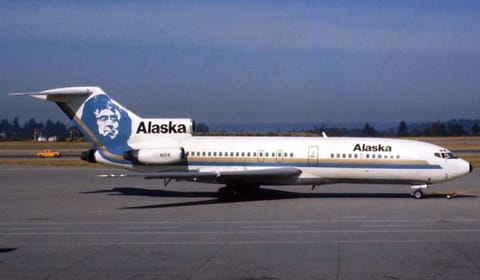
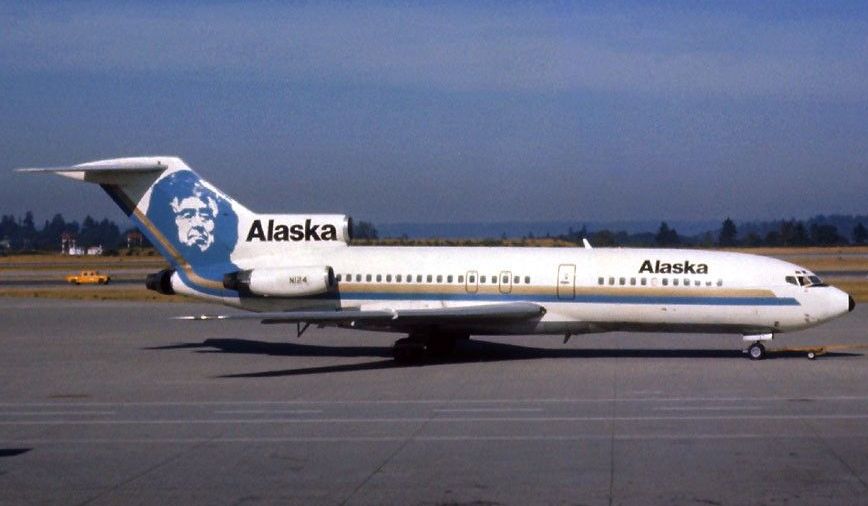
Alaska Airlines Flight 1866: Approach to Juneau, Alaska, 1971
On 4 September 1971, Alaska Airlines Flight 1866, a Boeing 727, was approaching Juneau, Alaska, on the fourth leg of a multi-stop service to Seattle. It flew into high ground in the Tongass National Forest, about 18 miles west of the airport. All 111 people on board died. The National Transportation Safety Board (NTSB) concluded that the crew had been given misleading navigation information and descended too early. It could not establish where that information came from.
At a glance
| Date | 4 September 1971 |
| Aircraft | Boeing 727-193, registration N2969G |
| Route | Anchorage to Seattle, with stops at Cordova, Yakutat, Juneau and Sitka |
| People on board | 111 (104 passengers, 7 crew) |
| Fatalities | 111 |
| Investigation | NTSB, report NTSB-AAR-72-28, adopted 13 October 1972 |
Background
The aircraft was built in 1966 and first flew with Pacific Air Lines. Alaska Airlines leased it in September 1970 and had flown it for about a year. It was powered by three Pratt & Whitney JT8D-7B engines. The NTSB found it properly maintained and in good working order.
The captain, Richard C. Adams, had been with the airline since 1955. First Officer Leonard D. Beach was flying the aircraft. Second Officer James J. Carson completed the crew. The NTSB found all three qualified and current, with no evidence of any condition that would have affected their work.
Juneau's airport sits at sea level, with mountains on three sides and a bay opening to the south-west. In 1971 the approach from the north-west was a non-precision approach. This means the crew had lateral guidance from a radio beam but no electronic glide path, so they had to manage their descent themselves against published minimum altitudes. The lateral guidance was a localizer, a radio beam that tells a pilot whether the aircraft is left or right of the runway centreline.
The flight
Flight 1866 left Anchorage on time at 09:13 local time. Cordova and Yakutat passed without incident, and the aircraft left Yakutat for Juneau at 11:35 with 104 passengers and seven crew.
At 11:46 the crew reported at 23,000 feet. Anchorage air traffic control cleared them to descend, at their discretion, to cross a navigation fix named PLEASANT at 10,000 feet. The crew began the descent at 11:51. A few minutes later they were told to level off at 12,000 feet. Along the way, Flight 1866 also passed messages between the controller and a light aircraft that was out of direct contact.
The crew was then handed to Juneau Tower and reported over BARLOW, a fix on the approach path. That was the last transmission from the aircraft. The accident occurred at about 12:15 Pacific Daylight Time (19:15 UTC), at roughly 2,500 feet on high ground on the approximate line of the approach course. The aircraft was well short of the point the crew believed it had reached.
The investigation
The recorders and radio tapes were recovered quickly. They showed an aircraft and crew operating normally. Both navigation receivers on board and the ground stations involved were later found to be working correctly.
The NTSB found that the crew had been shown navigation information that placed the aircraft further along the approach than it really was. They descended below the minimum safe altitude for their actual position. The Board's probable cause was a display of misleading navigational information about the flight's progress along the localizer course, resulting in a premature descent below obstacle clearance altitude. It added that the origin or nature of that information could not be determined.
The Board also commented on how the crew had monitored the approach. It said they did not use all the navigation aids available to check their progress, though no rule required them to. They also did not carry out the required audio identification of the relevant navigation stations. This is a check where the pilot listens to the Morse code identifier a station transmits, to confirm it is the right one. The Board did not present these points as the cause. It treated them as missed chances to catch the discrepancy.
Several explanations were examined, from equipment faults to signal interference and cockpit coordination. The evidence did not support any single one. The report also described the accident as non-survivable.
Unresolved questions
The official finding left room for continued argument. Alaska Airlines and the Federal Aviation Administration were in dispute over responsibility. Airline investigators pursued their own inquiry, and accounts of that work say they found a nearby navigation beacon had not been set up to the FAA's own standards. The NTSB reviewed the accident again in 1994 as part of a wider look at safety around Juneau, but the cause remained officially undetermined.
Legacy
Reporting on the accident records that the FAA installed distance-measuring equipment at the Sisters Island beacon before the end of 1971. Such equipment shows a pilot how far the aircraft is from a station. It would have given the crew of Flight 1866 an independent check on their position.
The accident belongs to an era in which controlled flight into terrain, where a serviceable aircraft under crew control strikes the ground unawares, was the most common cause of fatal airline accidents. It strengthened the case for independent cross-checks of position and for terrain warning systems in airliners, which later became standard.
At the time, Flight 1866 was the deadliest single-aircraft accident in United States history. It held that position until Eastern Air Lines Flight 66 crashed on 24 June 1975. It remains the deadliest air accident in the history of Alaska, and it was the first fatal jet crash for Alaska Airlines.