
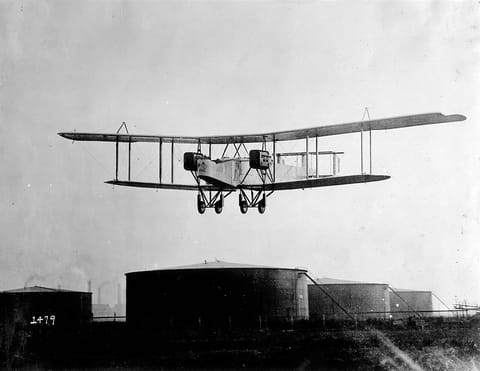
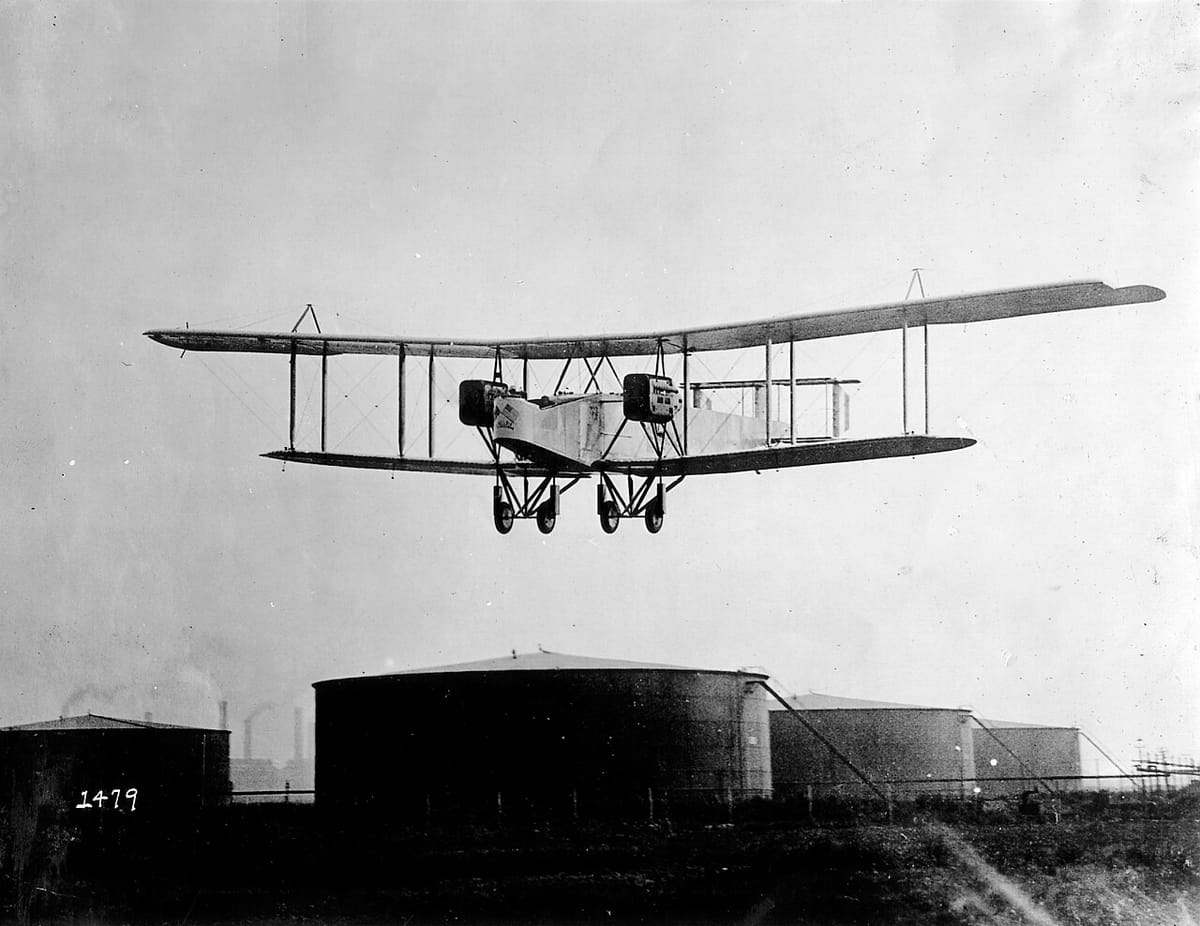
Golders Green Handley Page O/400 Crash, London, 14 December 1920
On 14 December 1920 a Handley Page O/400 biplane left Cricklewood Aerodrome in north London on a scheduled service to Paris. It never climbed far above the rooftops. Within a short distance it struck a tree and came down in a garden at Golders Green. Four of the eight people on board died, and the inquest could not determine why the aircraft had failed to gain height.
Key facts
| Date | 14 December 1920 |
| Aircraft | Handley Page O/400, registration G-EAMA |
| Operator | Handley Page Transport |
| Route | Cricklewood Aerodrome, London, to Le Bourget, Paris |
| People on board | 8 (6 passengers, 2 crew) |
| Fatalities | 4 (both crew and two passengers) |
| Survivors | 4 |
| Inquest | Hendon, 16 December 1920; cause not determined |
The aircraft and the airline
G-EAMA was a large twin-engined biplane, configured to carry seven passengers. It began life as a military machine. The Birmingham Carriage Company built it, and it was delivered to the Royal Air Force as a bomber during the First World War. Like many surplus aircraft, it found a second career after the Armistice. In 1919 Handley Page converted it for passenger use, and it joined the fleet of Handley Page Transport.
The company had begun its scheduled services in December 1919, so the crash came almost exactly a year into its operations. It was the first fatal accident the airline had suffered since the service started.
The flight
The aircraft left Cricklewood at about midday (around 12:00 Greenwich Mean Time, the same as UTC in December). On board were six passengers, together with mail and freight for Paris. The weather was misty.
Witnesses saw the aircraft flying low after take-off. It struck a tree and fell into the back garden of a newly built house at Golders Green, close to the aerodrome. The aircraft caught fire after it came to rest.
Four passengers got clear of the wreckage. Two of them were unhurt and the other two were only slightly injured. Local people ran to help, but the fire prevented any approach to the aircraft. The Hendon Fire Brigade put out the fire and attended to the scene. The aircraft was destroyed and the house was badly damaged.
The Times reported the accident the following day under a headline describing a burning aeroplane in a garden near Cricklewood.
The inquest
An inquest into the four deaths was held at Hendon on 16 December 1920, two days after the crash. Several people gave evidence:
- A surviving passenger, who had watched the engines being tested before departure and heard nothing to suggest a fault.
- Another passenger.
- The dispatcher, and one of the first people to reach the scene.
- A ground engineer.
- The pilot who had flown the same aircraft the day before.
The surviving passenger told the court that the aircraft never rose above about 100 feet before it suddenly struck a tree. After the impact he climbed over the debris and left through a window.
The tree was under 50 feet high, so the aircraft was very low when it hit it. Even so, the evidence did not show why. Nobody reported a problem with the engines, and the inquest heard nothing that pointed to another cause.
The coroner recorded that the deceased died as a result of the aeroplane striking a tree and crashing to the ground. He added that the evidence before him was not enough to establish a cause.
What the record can and cannot say
Modern classification would describe this as controlled flight into terrain. That is an accident in which an aircraft that is still under the pilot's control flies into the ground or an obstacle. The label describes what happened, not why. Without a technical investigation of the kind that is routine today, the reasons for the poor climb performance remain unknown. Possible factors such as the misty weather, the aircraft's loading or engine performance can be listed, but none was established by the inquest.
Legacy and significance
The accident was reported at the time as the first recorded airliner crash. That description does not hold up, because a larger airliner had crashed the previous year. It is better described as the first fatal accident to a Handley Page Transport aircraft on its London to Paris service.
It is a useful reminder of how early commercial flying was investigated. In 1920 an inquest led by a coroner was the main public inquiry into an air accident. Coroners heard from witnesses and recorded how people died, but they were rarely equipped to examine wreckage or analyse an aircraft's performance. Because the cause here was never found, there is no safety change that can be tied directly to this accident. The record is nonetheless an early example of the questions that later formal investigations would be set up to answer.