
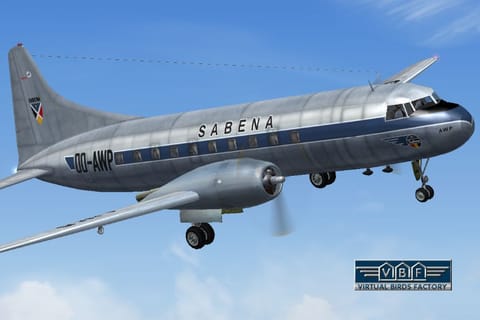
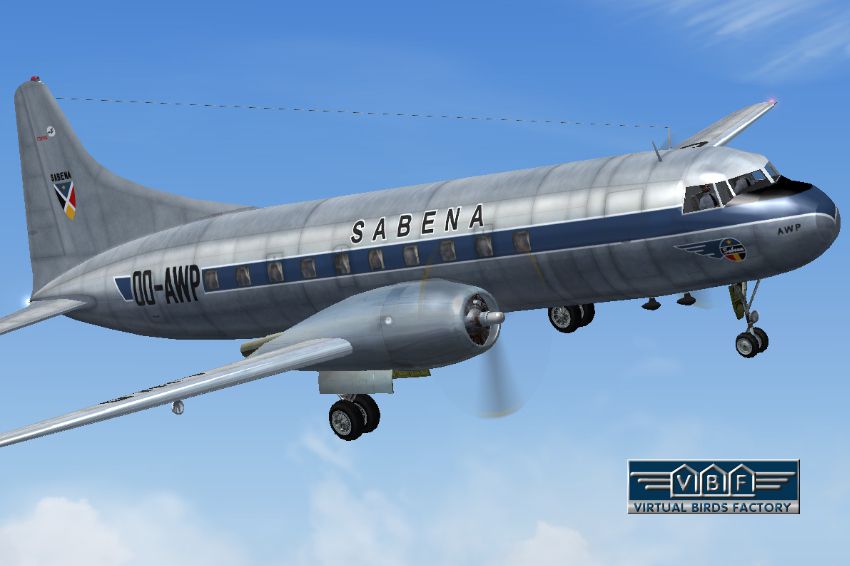
Sabena Convair CV-240: Loss of Power after Take-off, Frankfurt, 1953
On the afternoon of 14 October 1953, a Sabena Convair CV-240 took off from Frankfurt on the middle leg of a service to Brussels. Within moments both engines lost power. The aircraft stalled and came down in woodland near Kelsterbach, a short distance north of the airport. None of the 44 people on board survived. The investigation traced the power loss to a gradual build-up of lead on the spark plugs.
Fact box
| Date | 14 October 1953 |
| Aircraft | Convair CV-240-12, registration OO-AWQ |
| Operator | Sabena |
| Route | Salzburg, Austria, to Brussels (Zaventem), with a stop at Frankfurt |
| People on board | 44 (40 passengers, 4 crew) |
| Fatalities | 44 |
| Site | Woodland near Kelsterbach, north of Frankfurt International Airport, West Germany |
| Probable cause | Loss of engine power attributed to lead deposits on the spark plugs |
Summary
The aircraft had arrived at Frankfurt from the south and was due to continue to Brussels with 40 passengers and four crew. Shortly after take-off, in the initial climb, the crew noticed that both engines were losing power. The aircraft could not hold flight, stalled and crashed. It was destroyed by the impact and the fire that followed.
Background
The aircraft and the operator
The Convair CV-240 was an American twin-engined, piston-powered airliner built to replace the Douglas DC-3 on short and medium routes. The accident aircraft was a CV-240-12, serial number 154. It was built in 1949 and delivered to Sabena, the Belgian national airline, in the spring of that year. It stayed in Sabena service until it was lost.
The service
The flight was a scheduled international passenger service that began in Austria and called at Frankfurt before continuing to Brussels. Published records differ on whether it began at Salzburg or Klagenfurt, and they also differ slightly on the exact departure time. They agree that the accident happened in mid-afternoon, at about 15:20 local time according to most accounts. Among the passengers were an Austrian diplomat and his wife.
The flight
The take-off from Frankfurt appeared normal until the aircraft was just above the ground and climbing. At that point the crew noticed both engines losing power. They followed standard procedure and raised the flaps. Flaps are the hinged surfaces on the wings that give extra lift at low speed, and raising them reduces drag.
With power falling away at low height and low speed, the aircraft could not be kept flying. It entered a stall, which is the condition in which the wings no longer produce enough lift to support the aircraft. It then came down in a wooded area near Kelsterbach, roughly two miles north of the runway it had just left.
Smoke from the wreckage guided fire crews and ambulances to the site. Rescuers soon found that nobody on board had survived. Only scattered pieces of the aircraft remained among the trees. German press photographers filmed the crash site about a week later, on 21 October.
The investigation
The investigators attributed the loss of power to a heavy deposit of lead on the spark plugs. Spark plugs ignite the fuel and air mixture in each cylinder of a piston engine. Once a conductive layer of deposit has built up on them, they can short-circuit and stop firing properly. In this case the report indicated that the plugs warmed up during the take-off, and the deposits then allowed current to leak away, so that the engines faltered.
The report said that nothing pointed to any other contributory cause. It also found no evidence that the lead coating had formed suddenly. The process had been continuous, meaning the plugs had been deteriorating over time rather than failing in a single event. The investigators could not tell, from the data available, whether the overhaul intervals the engine makers specified for the plugs were adequate in every case.
Some later summaries of the accident raise a further question: whether the decision to continue the take-off, and the raising of the flaps at low speed and low height, played any part. The same summaries acknowledge that the loss of power on both engines may simply have been too severe for any crew action to change the outcome. The record available today does not settle that point. What is clear is that a double engine failure at very low height, with no room to recover, left the crew with extremely limited options.
Legacy
The accident is recorded as the worst involving the CV-240 family. Its main lesson concerned maintenance and engine reliability rather than flying technique. The findings pointed to how long spark plugs should stay in service, and how quickly lead fouling can develop in piston engines. They also showed that a fault affecting both engines of a twin at once can leave very little margin during the first minute of a climb.
The Convair 240 and its relatives continued in airline service for many years afterwards. Piston engines gradually gave way to turbine power, which does not use spark plugs in the same way and is much less prone to this kind of fouling. The Frankfurt accident remains one of the early cases in which a common-cause failure across both engines was traced to a gradual process, rather than a sudden fault.