
Aerolínea Lanhsa Flight 018: Loss of Control after Take-off, Roatán, 2025
On the evening of 17 March 2025, a twin-engine turboprop took off from Roatán, an island off the north coast of Honduras, bound for the mainland city of La Ceiba. It climbed only a few feet, veered to the right and struck the sea about a kilometre from the coast. Twelve of the 17 people on board died and five survived. The Honduran investigation has not yet published a probable cause.
Key facts
| Date | 17 March 2025 |
| Aircraft | British Aerospace Jetstream 32, registration HR-AYW, built in 1989 |
| Operator | Aerolínea Lanhsa (Línea Aérea Nacional de Honduras) |
| Route | Juan Manuel Gálvez International Airport, Roatán, to Golosón International Airport, La Ceiba |
| People on board | 17 (15 passengers, 2 crew) |
| Fatalities | 12 |
| Survivors | 5 |
| Investigation | Honduran Commission for the Investigation of Aviation Accidents and Incidents (CIAIA) |
Background
The Jetstream 32 is a small airliner powered by two turboprop engines, which are gas turbines that drive propellers. HR-AYW had two Honeywell TPE331 engines. The flight to La Ceiba is a short hop of about 35 nautical miles, and it was listed as a charter service.
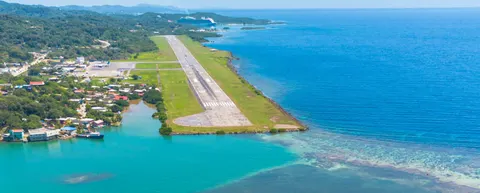
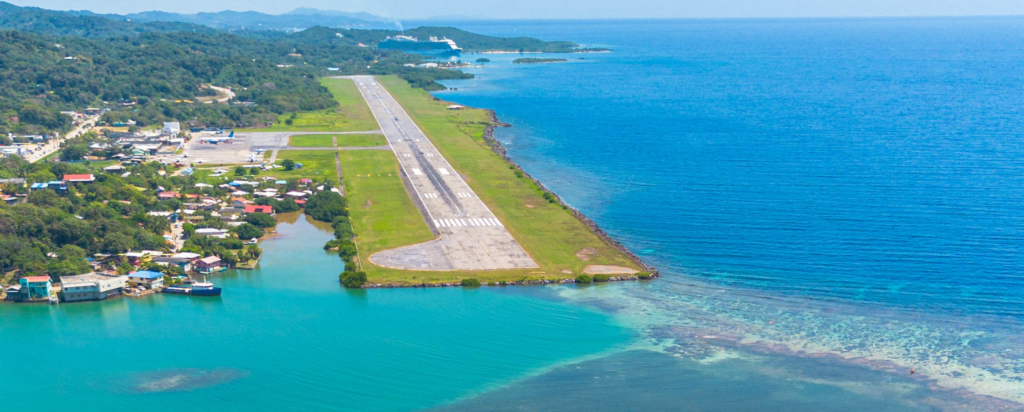
Roatán's runway 07 points out over the water, so an aircraft that fails to climb after take-off has very little land beneath it. The sea in the area is rocky and, in places, deep. This shaped both the rescue and the later work to examine the wreckage.
The flight
Reported times differ slightly. The Honduran civil aviation authority gave 18:18 local time, and the preliminary report gave 18:25. Honduras is six hours behind UTC, so these correspond to about 00:18 to 00:25 UTC on 18 March. It was early evening, and the aircraft took off from runway 07 with two pilots and 15 passengers.
The CIAIA preliminary report describes the take-off run in brief terms. The aircraft rose to roughly 20 to 35 feet above the ground and then turned off to the right of the runway. The report says control was lost and the aircraft hit the water. Local authorities and police said early on that one engine had lost power. That remains a working account until the investigation confirms it.
The wreckage came to rest about 150 metres from the edge of the airport, at a depth reported as between 50 and 60 metres. Police, fire crews and other responders reached the area quickly and brought five people ashore. The seabed made the search difficult. President Xiomara Castro activated an emergency committee, and hospitals in San Pedro Sula and La Ceiba prepared to receive patients.
The investigation
The CIAIA leads the inquiry. Honduran law gives it 30 days to issue a preliminary report. International practice under ICAO Annex 13 asks for a final report within 12 months, or an interim statement on each anniversary if that is not possible. A team from the aircraft's manufacturer travelled to Roatán on 20 March to assist.
Preliminary report, 25 April 2025
The preliminary report was mostly a description of the flight path. It gave the sequence above and the position and depth of the wreckage. It did not discuss causes.
Interim report, March 2026
An interim report followed on 18 March 2026. It recorded that the right engine was found detached from its mounting on the wing, while the left engine stayed attached. Honduran authorities had also noted that the propeller blades on both sides were deformed. Such findings describe the state of the wreckage. They do not on their own show whether damage came before the impact or from it, and the report does not draw that conclusion.
The interim report also confirmed that the aircraft had no flight data recorder (FDR), the device that logs speed, altitude, engine settings and other parameters. The civil aviation authority had earlier granted this aircraft an exemption to operate without one. The cockpit voice recorder (CVR), which records sounds and conversation on the flight deck, had not been recovered when the report was issued. Without recorded data, investigators must rely more heavily on the wreckage, maintenance records, witness accounts and the aircraft's performance.
The CIAIA has stated that the report does not name a probable cause or assign responsibility. Its stated aim is to gather technical information so that similar events can be prevented.
What is not yet known
Several questions are still open:
- Why the aircraft stopped climbing and turned right at such a low height.
- Whether an engine failed first, and what condition the engines and propellers were in before the flight.
- How the maintenance history and any earlier technical reports on the aircraft relate to the accident.
- Whether the missing flight data recorder limits what the final report can establish.
Early press reports and some reference sites carried different totals for the number on board and the number of deaths. The civil aviation authority and the investigation's published reports give 17 people on board, with 12 killed and five surviving.
Legacy
Aerolínea Lanhsa ended all operations in April 2025, within weeks of the accident. The case has drawn attention in Honduras to flight recorder requirements and exemptions for older regional aircraft, and to the resources available to the accident investigation body. The final report is expected to say what happened in the seconds after take-off and whether any regulatory or operational changes are needed. Until then, the published findings are limited to the flight path, the condition of the wreckage and the absence of recorded flight data.